I’m not going insinuate that TV was better when I was a child because, quite frankly, I don’t think it was. Kids’ shows then were equally impactful as they are to children today, just.. different. This post will strictly talk about actual shows and feelings I remember from childhood, and will not delve into cartoons, which is an entirely different category worthy of it’s own post.


Life BC: Before Color, Before Cable, Before Computers, Internet, Streaming
The black and white TV pictured is similar to what I had in the early 1950’s. “Rabbit Ears” was how, unless you had a master TV antenna mounted to your home’s roof, you received broadcast signals from what usually amounted to three different available network stations (CBS, NBC, ABC) in each major market. Your TV’s picture quality was usually dependent on how far your home was from each TV station’s broadcast antenna; the best picture quality for each station was usually achieved by positioning, repositioning, and adding foil to, each rabbit ear. Remote controls did not exist—channels where changed, volume adjusted, by manually turning knobs on the TV. (Note: rabbit ears shown are after early 1950’s. UHF stations, usually double digit channel numbers, emerged in the early 1960’s. The wire loop was for UHF signal reception.)
Ages 3 to 5: All about shows with hosts and kids in audience
The 1950’s was a different era. Parents controlled the TV, what you watched, when you watched it. TV was not a babysitter. Unless it was a rainy day, kids were expected to play outside, without leaving the yard, come in for lunch, have a nap, then play outside until dinner. When you did leave the yard, it was only with permission, and only to a friend’s house either across the street or next door. TV time was limited and highly controlled.
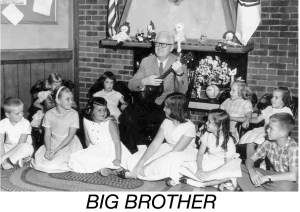
During the age 3-5 era, Big Brother with Bob Emery, a local show in Boston, was about the only TV I was actually allowed to watch. His show made you feel special as a member of the Small Fry Club, and was educational, with continuous features on current events, travel, music, ethics. Each day Bob and the Small Fry Club would toast the President of the United States (Eisenhower) by lifting a glass of milk to his framed portrait while Hail to the Chief played. I tried not to miss a show, or a toast to the President. Even the show’s theme song, The Grass is Always Greener in the Other Fellow’s Yard, sung by Bob while he strummed his ukulele, was meant to teach kids to be grateful for what they had.
Shows I was not allowed to watch


Every afternoon, You hoo, it’s me…my name is Pinky Lee would open this slapstick comedian’s The Pinky Lee Show where, in his checkered suit and shirt, Pinky would dance, fall, stumble, tell jokes and act crazy for the amusement of kids. Directly after The Pinky Lee Show came The Howdy Doody Show, where Buffalo Bob Smith and his marionette puppet Howdy Doody— which had exactly 48 freckles, one for each state in the union at that time— would entertain kids in TV Land, and the show’s Peanut Gallery, with jokes, and ongoing guests like Clarabell the Clown. My mother considered these shows to be “junk”, of no value, educational, or otherwise. So, whenever possible, I would try to be at my best friend’s house across the street every afternoon, after nap, to watch. Consequently, my exposure to, and memories of these shows are limited. In retrospect, I believe they were entertaining, fun, engaging to kids. (No offense, but “lighten up, Ma.”)
Ages 5 to 7: Captain Kangaroo, Captain Midnight and Cowboy Hero Years


 We moved from Massachusetts to Illinois for two years when I was five. By 1955 TV hero shows had hit their stride. But, before the heroes were on, each day would begin at the Treasure House with Captain Kangaroo, Dancing Bear, Moose, Bunny Rabbit, Grandfather Clock, Radio, and Mr. Green Jeans. From teaching kids “please and thank you” to influencing kids to read, draw, sit still, and be calm at times to learn— to asking parents to spend quality time with their kids— Captain Kangaroo was one of those all around good guy influences, the best of his era.
Then came the heroes, usually on Saturdays. The formula for hero shows was pretty much standard: Hero fights bad guys, has comedic sidekick who usually somehow ends up saving the day when hero gets in trouble, hero puts bad guys in jail. Captain Midnight was the only “hero” show I recall that was not a western. He, with his supersonic jet plane, was a scientist and crime fighter. As members of Captain Midnight’s Secret Squadron, I, and all kids watching, helped fight crime. And, with a special coupon inside the lid of Ovaltine, you could send for, and receive, the coveted Captain Midnight Secret Decoder Ring. Thanks to Captain Midnight, I, too, was a superhero as I sat with my Secret Squadron Certificate and Decoder Ring helping beat the bad guys.
The Roy Rogers Show was captivating to me, not only because he fought outlaws, but also because his horse Trigger did amazing tricks, his German Shepherd Bullet was truly a wonder dog, and NellyBelle, the Jeep, had it’s own personality. I would also wait with anticipation for the end of each show, as I knew that Roy Rogers and Dale Evans would sing Happy Trails to You and wave to me, just me. Remember, I was five and six.
The Gene Autry Show was equally captivating— this cowboy was always different; a Rancher, a ranch hand, a sheriff, a border agent. He truly was a singing cowboy hero and I sang along with him, his theme song, I’m Back in the Saddle Again, at the beginning of every show. His comedic sidekick, Pat (played by Pat Buttram, later Mr. Haney on Green Acres) aways helped save the day. Alan Hale Jr., later The Skipper on Gilligan’s Island had recurring parts playing a bad guy on The Gene Autry Show. My biggest thrill was actually getting to see Gene Autry perform live, at a rodeo, with his horse Champion.
I don’t remember too much about The Adventures of Wild Bill Hickok, other than his comedic sidekick, Jingles, played by Andy Devine, had a high-ish pitched, really raspy voice. Word was that as a child he swallowed a lollypop stick which damaged his vocal chords. I don’t have to tell you that every time The Adventures of Wild Bill Hickok was on, the lesson, and warning about lollypop sticks, was repeated by my mother. Range Rider is another blur, I remember watching it, but don’t remember anything about the show.
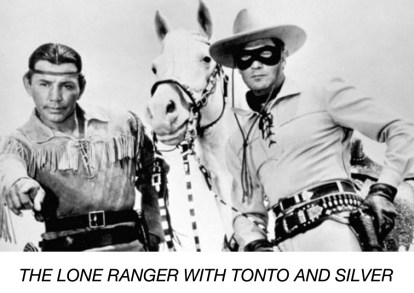
The Lone Ranger became a must see. Somehow the mask, his Stallion Silver, his sidekick Tonto, who was an equal hero, saving The Lone Ranger’s butt in every episode, the silver bullet and the predictable “who was that masked man, anyway” at the end of each show were intriguing. And, I don’t believe I was the only child then yelling “Hi ho Silver. Away!”
Although the heroes were different, these shows all had one thing in common; no one ever seemed to die. Instead, guns were shot out of hands, or if someone did get shot, there was no blood, and they lived to go to jail, because justice meant that bad guys belonged in jail, not dead. Cheap? Maybe. But, as a child, these shows somehow all made you a part of them—made you want to be a good guy helping fight the bad guys, and didn’t make you want to kill anyone. It was great to have heroes.
Life changed after age 7: Heroes were replaced by cartoons and Stooges


 I don’t recall how my childhood obsession with heroes fighting outlaws evolved into an obsession with cartoons, but I do know it happened, at age 7, when we moved back to Massachusetts. Local origination shows from Boston became less about involvement, and more about the cartoons they showed. Major Mudd, who was on every afternoon, was a ridiculous character (but funny), who was supposed to be an astronaut, complete with cheap football helmet as part of his spacesuit. He did nutty stuff every day, including putting a phone receiver up to his helmet, having equally ridiculous conversations, talking, and hearing, through that dumb helmet. “I’ll be blasting you” were his final words on every show. As stupid as the show was, I was there every afternoon for the cartoons and, I guess, I also thought Major Mudd was kind of funny. (Bostonians who remember Major Mudd may also remember that Ed T. McDonnel, who played the character, was also the voice of Feep on Fantasmic Features, and also played Lord Bumblebrook.)
Boomtown with Rex Trailer was the weekend morning TV show in Boston that had the most cartoons, so it, too, became a staple. Every Saturday and Sunday morning Rex and his sidekick Pablo, plus Rex’s horse Goldrush would air a 3 hour live show, chuck full of cartoons.
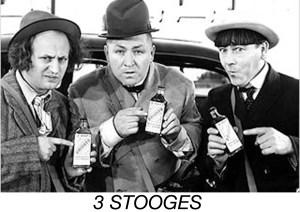
Last, but not least, came the 3 Stooges. By the time I was eight, UHF TV had emerged, and Channel 38 in Boston aired Stooges shorts every morning, which meant waiting until the very last minute to run to catch the school bus. Where most adults saw only slapstick, I was getting to an age where, in addition to the slapstick comedy, I was realizing some of the social content and satire in every Stooges short. The meaning of “Fine for fishing” depended on how you emphasized the word “fine” on the sign. “Pardon me, are you happy or married”? speaks for itself. “We’re three restless knights”. “Ya and our days ain’t so hot either”. Good, bad, or indifferent, The 3 Stooges stuck with me, I think much of their commentary and satire applies today,and their comedy, timing, and execution of tough routines were flawless.
Whatever today’s children are watching…it will stick with them
I believe there are some great shows on PBS and NIK. I don’t doubt, for a minute, the impact any of these shows will have on children between the ages of three and six— that is a magical age when young children’s TV heroes, and/or role models, are totally believable, absolutely real.
In today’s world, I think we adults have to be most concerned with impacts the shows we watch, including the news, have on young children. If young children are in the room while we watch our shows, then these shows, also, will make as much of an impression, and have as much of a lasting effect, as the kids’ shows do. At that age, TV is magical. At that age, children are members of today’s equivalents of Captain Midnight’s Secret Squadron, cherishing, proud of their Secret Decoder rings and believing they are part of what is going on in television land. To young children, what they see and on TV is very, very, real.
 Old Dude Journal®